About"NOTHING"
How Physicists and Philosophers View Concepts of Nothingness
What is Nothingness?
Nothing, or nothingness, is the state of nonexistence, or the absence of anything. Although that explanation seems simple, its concept had troubled physicists and philosophers over the ages. Let's see why.

What Is Nonexistence?
According to Merriam-Webster's dictionary, nonexistence is the negation of being.
There are several ways to refer to it:
- zero
- nada
- null
- empty
- vacant
- vacuum
- void
All of these relate to the idea of nonexistence. There is more of this "nothingness" than these simple terms. When we try to understand nothingness mathematically, we get into an entirely new philosophy that leaves us confused.
What Is the Concept of Nothingness?
The concept of nothingness is complicated to explain. Comparing it to something one can envision might help. You might consider it to be a void or a vacuum.
Another way to express it is mathematically. We think of nothing as "zero" when we define it mathematically. But due to its complicated nature, the Egyptians hated it and felt there was no need for zero. However, they did just fine building the pyramids without it. As a result, roman numerals have no representation for zero.
Charles Seife, professor of journalism at New York University and author of Zero: The Biography of a Dangerous Idea, explains nothingness as follows: "Zero minus zero becomes a null set. That's as close to nothing as I can imagine. And if you do the reverse, you put a null set in another null set, you create zero."
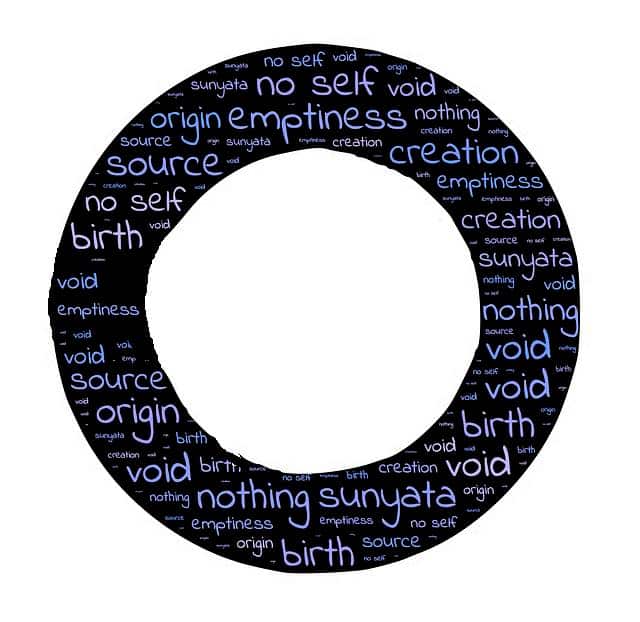
Nothing, zero, nada, emptiness, void.
The History of the Number Zero
The
Greek philosopher Aristotle never accepted the concept of division by
zero. He found too many paradoxes with it. I could explain the problems
he ran into with it, but it's beyond the scope of this article.
Suffice it to say that we interpret division by zero as infinity. Zero can go into anything an infinite number of times.
The ancient Greeks were aware of the concept of zero. After all, they knew when they had no stones.
And the Egyptians, well, they eventually acquired the use of the number zero from the Babylonians
Was the Universe Created Out of Nothing?
Quantum physics already shows us how a particle can go from existence to nonexistence and back again. That is quantum fluctuation.
It may actually be moving through time, so once it is no longer in the present, we no longer see it. We might consider it to have become "nothing" or "void" of existence.
Even while nonexistent, the energy never dissipates. Einstein's formula E=MC2 applies very well. Energy and mass cannot be made or destroyed. It merely changes from one to another as per Einstein's formula.
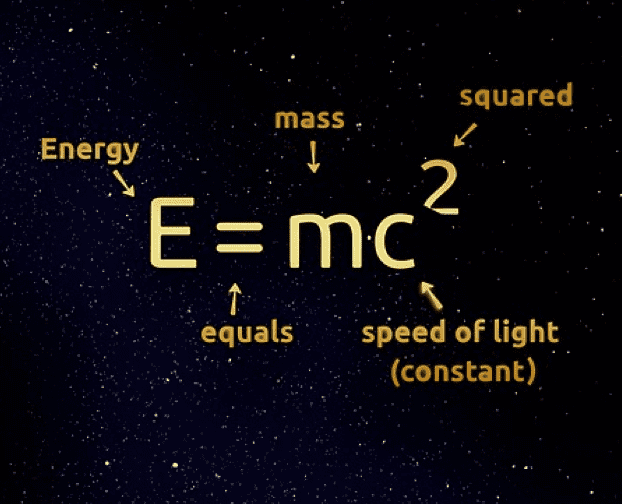
Einstein's famous formula: E = mc²
Is Empty Space Nothing?
As shown above by Einstein's formula, energy and mass cannot be made or destroyed. So that proves that the universe did not come from nothing. But where was all that energy before the beginning? There are two theories.
- One theory is the Big Bang, which indicates that all matter (and its energy equivalent) was compressed into a single black hole. That compression is possible because the universe is mostly empty between all particles.
- Another theory was proposed by Edward Tyron, an American scientist and a professor of physics at Hunter College in New York City. In 1973, he proposed the idea of a zero-energy universe that emerged from a vacuum of energy. That is to say, it emerged from nothing—where all the positive energy of mass is balanced by the negative energy of gravitation.
The Matter of Nothing in the Universe
All matter in our world contains a lot of nothing between its molecules and within its atoms. There is enormous emptiness between their nucleus and electrons. That means there is an entire factor of nonexistence within our physical world.
That explains how the entire universe could fit in a single black hole, and it could possibly reveal how the whole universe emerged with the Big Bang.
Nothingness Explained With Quantum Physics and String Theory
- Why am I bringing up String Theory? Because I'm going to show you how we can misinterpret the concept of "nothing" when something indeed does exist. We simply may not be aware of it for particular reasons.
- To understand string theory, you have to understand that time is the fourth dimension in mathematical terms.
- Our three-dimensional world exists in the present. However, it also moves forward in time.
- To understand this better, consider the fact that one dimension is simply a line. You can only move back and forth in the length of that line.
- If you go 90 degrees perpendicular to that line, you create a plain (a flat surface) where you can move in two dimensions: length and width.
- If you go 90 degrees perpendicular to that flat surface, you are moving in three dimensions: length, width, and height.
- If you consider another 90-degree turn, the three-dimensional space that we live in moves perpendicular at a 90-degree angle through the fourth dimension: Time.
- Note, however, that we can't see into that fourth dimension. We can't observe the past or the future. We can only remember the past, and we can only anticipate the future.
- String theory shows how we can observe an object wiggling around in a three-dimensional space. However, once that object wiggles in a fourth dimension, it leaves our awareness.
- It still exists, but we can't observe anything in dimensions beyond ours. It's just like a cartoon character that's drawn on a two-dimensional piece of paper. That character can't visualize what is happening above or below that flat surface.
A two-dimensional plane in a three-dimensional world
- As I think about this object wiggling around in a fourth dimension, I realize it is traveling through time because time is the fourth dimension. This consideration brings to mind that quantum physics may be related to string theory.
- Quantum physics has shown that particles can move from one location to another instantaneously without existing anywhere in between. String Theory can help explain how this works.
- That particle merely is wiggling into the fourth dimension. Once it's there, it is outside of our awareness. Eventually, it wiggles back into our three-dimensional world in a different location, and we see it again.
- Does that mean that it became nothing and then later became something again? If that particle merely is unobservable, then who's to say that it is nothing? Just because we can't see something doesn't mean it doesn't exist.
- I wonder if that's why the Egyptians hated zero. Perhaps they knew better. Maybe they knew something.
Why Is There Something Instead of Nothing?
- In the following TED Talk, Philosopher Jim Holt tries to describe how everything we know that exists in the universe was created from nothing. In my opinion, he failed to do that. But that demonstrates how difficult it is for philosophers to understand or describe the concept of nothingness.
- It’s best to avoid asking the question, "Why is there something instead of nothing?" A better question might be to ask, "How do you experience nothingness?"
- As I said at the beginning of this article, the concept had troubled physicists and philosophers over the ages, and it will continue to eternity.
- If you’re curious to see how Mr. Holt struggles with the explanation for 17 minutes, watch the video. But remember, it’s much ado about nothing.
How Do You Experience Nothingness?
- So I left you with that thought! And now you're wondering. Well, I'll end this article with my attempt at an explanation.
- We live in a three-dimensional world that travels through time. Within this conceptional world, we have everything.
- However, among everything, we have a bunch of null sets that are void of anything. But how do we experience that?
- My method is to do it in your mind. Imagine limiting our space of length, width, and height to a mere point (or dot). That dot has no dimension. It becomes void of anything.
- The problem is that it still exists in time. If it exists, then it cannot be void of anything. So we need to eliminate time from the equation, too, leaving us with a four-dimensional point with no width, length, height, or time!
That’s about the closest I can come to imagining nothing.
I hope I didn’t leave you feeling too empty!
keep learning.
Comments
Post a Comment